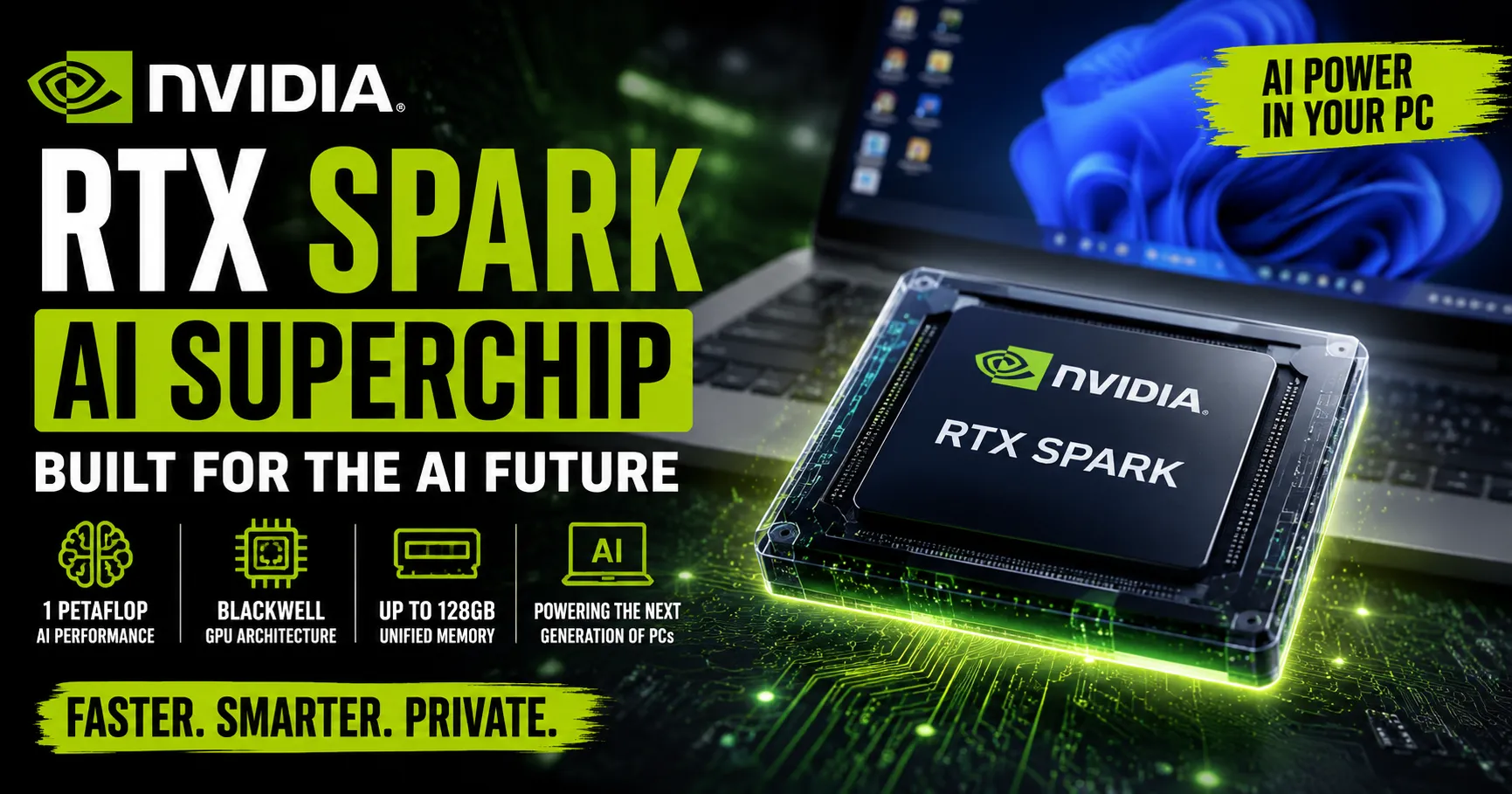
So the artificial intelligence race isn’t really staying in the cloud anymore, like it used to. It’s drifting straight into personal computers, in a way that feels kind of sudden, and also not. At Computex 2026, NVIDIA did a major reveal where it introduced the Nvidia RTX Spark, which is basically an AI-focused superchip meant to push forward the next wave of Windows laptops and desktop systems. A lot of industry experts are already saying this could end up being one of the biggest moments in PC history, and it might even reshape how people interact with their computers for years, if not longer.
The RTX Spark platform is made to bring strong AI abilities right on to the device, instead of making everyone lean on cloud computing all the time. That, Nvidia says, means faster performance, more private processing, and a smarter kind of everyday computing. And with Microsoft backing it plus major PC manufacturers on board, NVIDIA is treating RTX Spark as the base layer, the sort of cornerstone, for what it calls the AI-powered future of Windows PCs.
What Is Nvidia RTX Spark?
Nvidia RTX Spark is this sort of advanced system-on-chip, SoC thing that basically folds in a high-performance CPU along with the Blackwell GPU architecture, plus AI acceleration and unified memory, all into one platform. And yeah, unlike those typical Windows PCs where you have separate processors and separate graphics cards, RTX Spark feels more like it just locks everything together in a really efficient arrangement, rather than treating it as separate parts.
As described by Nvidia the RTX Spark “superchip” includes
- Up to 20 Arm-based CPU cores
- Blackwell GPU architecture with 6,144 CUDA cores
- Up to 128GB of unified LPDDR5X memory
- AI processing performance up to 1 petaflop
- Support for advanced AI agents , and generative AI workloads
With specs like that RTX Spark sits among the most powerful consumer compute platforms ever announced, or at least that’s the impression Nvidia is going for.
Why Nvidia RTX Spark Matters
For decades, the personal computer has been kinda run mostly through keyboards, mice, and touchscreens, you know. Nvidia says artificial intelligence will bring a totally new way to interact with technology.
Instead of having to manually open apps and pick through menus, people could just tell AI agents what they want, using plain natural language. These AI agents would be able to do tasks, sift through information, craft content, and even handle workflows in a pretty autonomous manner. Nvidia frames this shift like its going from computers being mere tools…to computers acting as smarter, more capable co-pilots or intelligent teammates.
If this lands the way they expect, it could boost productivity a lot for professionals, students, developers, content creators, and even businesses.
Local AI Processing Changes Everything
One of the most exciting parts about Nvidia RTX Spark is that it can let you run strong AI models on your own, like right there locally.
Right now, a lot of AI applications lean on cloud servers to handle requests. Sure cloud AI is powerful, but it also brings that extra latency, privacy headaches, and ongoing subscription expenses that never really end.
RTX Spark tries to untangle those issues, because it lets the AI workloads run right on laptops and desktops. That usually turns into a few practical wins, like
- quicker AI responses
- more robust privacy protection
- less of a need for reliable internet connectivity
- lower costs for cloud computing
- stronger enterprise security
For companies and people who work with sensitive information, this kind of on-device processing could end up being a big advantage, almost a differentiator.
Nvidia and Microsoft Join Forces
The launch of Nvidia RTX Spark is not happening in isolation. Honestly Microsoft has sort of become one of Nvidia’s key partners for this initiative, like right alongside them.
Microsoft said that RTX Spark-powered devices will be tightly integrated with Windows and upcoming AI agent technologies. The goal is to craft what Microsoft calls a new chapter for Windows PCs, and these are meant specifically for AI-driven experiences, not just general computing.
If this goes as planned it could speed up how fast AI gets adopted across the Windows ecosystem, and it might also sharpen the competitive edge versus Apple’s AI-powered Mac lineup, because that side is moving too.
Challenging Apple Silicon
Since the introduction of Apple Silicon , the MacBooks have kinda picked up a reputation for excellent performance, longer battery life , and that general kind of efficiency you notice in day to day use.
A lot of analysts think Nvidia RTX Spark is Microsoft’s most serious counter move so far. The chip brings AI acceleration, strong graphics, and energy conscious Arm architecture all together, in a way that sorta resembles Apple’s tried and actually proven approach.
If Nvidia really pulls through on the performance promises, then RTX Spark powered devices could give Windows users a real alternative. One that can match or even edge past Apple’s latest hardware, especially in a few AI centered workloads.
Designed for Creators and Developers
Content creators can really get a lot out of Nvidia RTX Spark, you know , if theyre working on stuff every day.
It’s designed to back up advanced creative tasks like video editing , 3D rendering, AI image generation , and even software development or machine learning. There’s also real time content creation, which is kind of the whole point.
Nvidia claims the chip can take on heavy creative workloads while still keeping power use efficient. On top of that, support for CUDA, RTX, DLSS, TensorRT, and OptiX helps it stay compatible with a bunch of professional software platforms.
And for AI developers, RTX Spark gives a strong local development environment, so you can run sophisticated models without needing to pay for costly cloud infrastructure all the time.
Gaming Performance Gets a Major Upgrade
Even if AI is kind of the main headline, Nvidia still hasn’t really let the gamers down.
RTX Spark brings Blackwell graphics tech to the table, and it is supposedly able to push high-end gameplay on thin, lightweight laptops. Nvidia also says that certain RTX Spark systems might hit around 100 fps at 1440p, and do it while keeping a bunch of advanced RTX features enabled.
Put together, this mix of gaming muscle and AI horsepower could make RTX Spark laptops pretty hard to ignore for power users. People who want one device for work, creating, and then later, just relaxing.
Major makers already in, or at least very close
A few big PC brands are already talking about RTX Spark powered models.
On the list you’ll find:
- Dell
- HP
- Lenovo
- ASUS
- MSI
- Acer
- Microsoft Surface division
The fact that so many companies are backing it this early, kind of hints Nvidia’s plan has real traction, even before the first consumer units show up.
When Will Nvidia RTX Spark Be Available?
Nvidia is expecting the first wave of RTX Spark powered laptops and desktop systems to roll in later on 2026. The premium devices, aimed at creators, developers, AI enthusiasts, and working professionals are also expected to launch first , and after that you’d see broader uptake across the Windows ecosystem.
Once more manufacturers end up joining the platform, RTX Spark might turn into a kind of standard groundwork for AI PCs , eventually.
The Future of Personal Computing
The arrival of Nvidia RTX Spark looks like a major move in the tech industry. Instead of leaning only on cloud AI services, it feels like the next chapter is more about strong local AI running right on everyday personal devices, not somewhere remote.
And with Microsoft on board, major PC makers in the mix, plus Nvidia’s broad AI ecosystem behind it, RTX Spark could really reshape what people think a computer should do. For work, for making things, for play, or even for AI development, this platform might end up being one of the most noticeable technology launches of the decade.