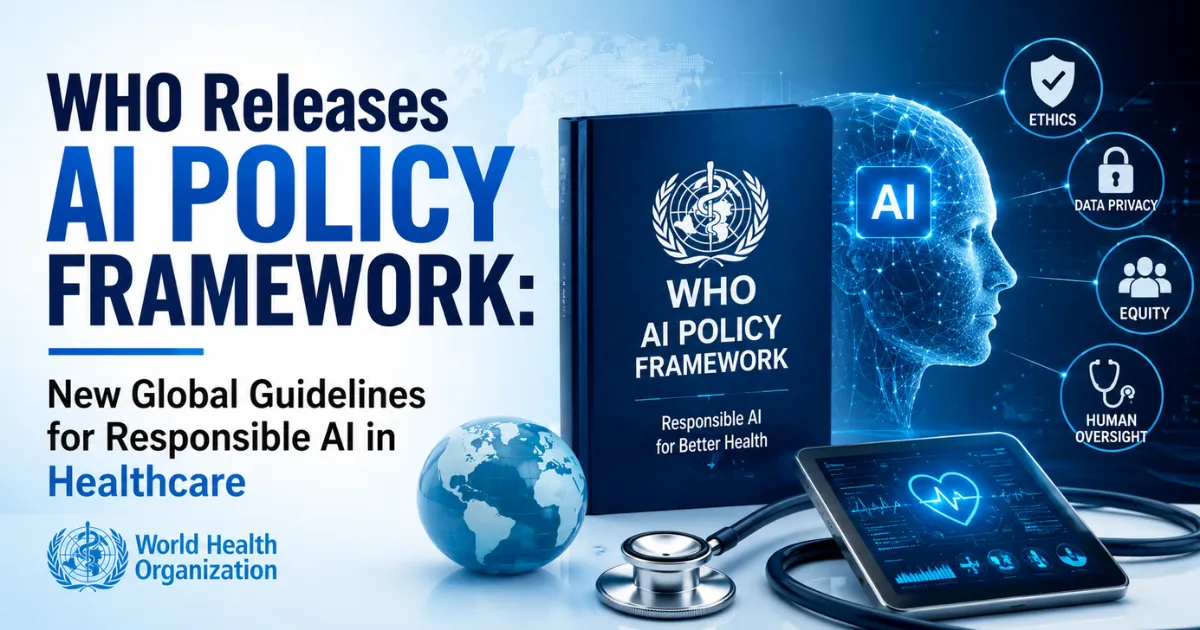
Artificial Intelligence is rapidly transforming the healthcare industry, enhancing the speed of disease diagnosis, improving hospital management systems, and broadly influencing related areas. Recognizing both the significant potential and the serious risks associated with AI in medicine, the World Health Organization (WHO) has officially released a new AI policy framework designed to guide governments and healthcare institutions toward responsible AI adoption.
This newer framework emphasizes evidence-based policymaking, ethical standards, transparency, and patient safety while using artificial intelligence within healthcare systems. As these AI technologies continue to evolve worldwide, the WHO’s latest initiative is viewed as a major milestone in shaping the next phase of digital healthcare.
Why WHO Introduced the AI Policy Framework
Artificial intelligence is getting more and more kind of stuck into healthcare systems worldwide. AI tools are now being used in medical imaging, disease prediction, hospital administration, drug discovery, robotic surgeries, and even virtual health assistants. Even if these novelties bring big opportunities, they also raise hard concerns about privacy, misinformation, algorithmic bias, and unequal access, which can feel kind of unfair.
The WHO AI Policy Framework was put out so countries can set up regulations and standards, to make sure these AI technologies stay safe, work well, are transparent, and stay ethical. It also stressed that AI should act like a support mechanism for healthcare professionals, not like something that simply replaces human judgment, period.
From what WHO experts say, healthcare AI systems have to keep human rights upfront always, protect patient dignity, and keep public trust intact.
Key Highlights of the WHO AI Policy Framework
So this new WHO AI policy framework, it kind of leans into a few basics that governments and healthcare organizations should really hold on to when they’re rolling AI into practice at scale you know. The message feels like slow down a bit, stay careful, stay responsible, and don’t push it live just because it’s flashy or impressive, or whatever.
- Evidence-Based AI Adoption
WHO basically said healthcare AI tools shouldn’t go into production unless they’ve got solid scientific research, plus real-world evidence backing them up. Like, these systems need proper clinical testing so they can show accurate results and safe outcomes—not just something that “works on paper”.
That matters because unreliable AI can lead to obvious issues, like wrong diagnoses, treatment missteps, and direct harm to patients which is not ideal. At all.
- Ethical and Responsible Use
The framework really nudges ethical AI hard. WHO also flagged discriminatory algorithms, the kind that can mess with people who are already vulnerable.
Healthcare AI should be built in a way that lowers bias tied to gender, race, income, location, or age. Policymakers are also encouraged to set up accountability structures, not only for the people building the AI but for the teams delivering care using it too.
- Data Privacy and Security
Healthcare data is extremely sensitive, and WHO highlighted the need to safeguard patient information. The framework talks about strong cybersecurity, secure data storage, and clearer rules for how data gets shared.
Governments are also told to make sure patients actually understand how their data will be used by AI systems. Not like “we mentioned it somewhere” but in a clear and understandable manner.
- Human Oversight Remains Essential
One of the biggest points here is that AI should never fully replace healthcare professionals. Doctors, nurses, and other medical experts have to stay involved in the decision-making.
The idea is that AI works as a supportive tool, helping improve healthcare efficiency and patient results, rather than pretending it’s a total substitute for human clinical knowledge.
- Global Collaboration and Regulation
WHO encouraged countries to collaborate on international AI standards for healthcare. Since AI tools are built, marketed, and used across borders, global coordination becomes pretty necessary to handle the risks.
WHO also stressed how useful it is to exchange proven practices and research outcomes across nations so no country has to keep redoing the same groundwork again and again.
Growing Role of AI in Modern Healthcare
This WHO AI Policy Framework lands right when AI adoption in healthcare is speeding up a lot, pretty much everywhere.
Hospitals are using AI-driven tools for early disease detection, predictive analytics, patient monitoring, and more customized treatment plans. Often AI can process huge medical datasets within seconds, helping clinicians move faster and decide more accurately.
For instance, AI-powered imaging tools already assist radiologists in spotting things like cancer, pneumonia, and neurological disorders with better accuracy.
At the same time, AI chatbots and virtual assistants are being used for everyday guidance, appointment scheduling, and mental health support too, in a quick-help style.
Even pharma companies are putting in serious effort into AI for drug discovery and improving clinical trial design.
Concerns Surrounding Healthcare AI
Still, AI in healthcare comes with concerns that WHO is trying to address through this framework.
Algorithmic Bias
Most AI models learn from large datasets. If those datasets contain bias, or they just aren’t diverse enough, the system can end up producing unfair outcomes for certain groups.
That can create gaps in diagnosis and treatment suggestions across populations, and then it can snowball into bigger inequality.
Lack of Transparency
Some AI models act like “black boxes” meaning even the creators may not easily explain how a particular decision was reached.
WHO emphasized healthcare AI should be transparent and explainable so stakeholders can understand, evaluate, and trust what’s going on behind the scenes.
Cybersecurity Risks
Healthcare platforms are getting targeted more and more by cyberattacks. AI-powered systems that manage patient records can become easier targets when security controls are weak or ignored.
So yes, cybersecurity can’t be treated like some afterthought.
Overdependence on Technology
WHO also warned against overreliance on AI. Too much automation, especially when it quietly becomes the default option, may gradually weaken human judgment and clinical decision-making.
Impact on Global Healthcare Policies
The WHO AI Policy Framework is expected to shape healthcare regulation across the world. Lots of governments are already drafting AI laws and digital health strategies, and WHO’s guidance could end up acting like a baseline reference.
Countries with developing healthcare systems might benefit especially from structured AI governance because it can support innovation while still protecting patient safety.
It may also push tech companies toward more open practices and more responsible AI development.
And most observers think that in the next few years, healthcare organizations, AI startups, and policymakers will likely adjust their approaches to better match WHO recommendations, in some form or another.
AI and the future of healthcare
AI could really flip the whole healthcare picture around, by making care more reachable , more affordable, and honestly much faster in practice. That said most specialists also seem to say the same kind of thing, responsible governance is gonna matter a ton, if these tools are actually going to help people, and not just look impressive on paper.
The WHO’s new framework feels like a solid step , toward keeping innovation moving, while still keeping ethical responsibility right there , close by.
And as AI keeps changing healthcare systems around the world will keep running into the same annoying headache: how do you add advanced tools without losing trust, safety, and fairness all at once.
The WHO AI Policy Framework is kind of saying this, the next chapter in healthcare shouldn’t be driven only by tech progress, but also by human centered values, in a way that works in real life not just in theory.
Final Thoughts
When the WHO AI Policy Framework was released, it became a noticeable moment for global healthcare and the tech world. With an emphasis on ethical standards, transparency, patient safety , and evidence based implementation, WHO is trying to help countries move toward responsible AI adoption.
Once artificial intelligence starts showing up more and more inside healthcare systems, clear policies and some real global cooperation will likely be needed, to reduce risks and also to increase the good outcomes.
So yeah, the healthcare industry is sliding into a new digital age. And WHO’s latest push could end up having a major influence on how AI tools improve lives, across the world in the years ahead.