OpenAI’s video generation technology is maturing fast — and the implications go far beyond content creation
There’s a quiet revolution happening in how video gets made. Not in Hollywood studios or high-end production houses, but in the hands of solo creators, small businesses, and teams who never had access to those resources in the first place. At the center of that shift is Sora 2 AI — the widely anticipated next step in OpenAI’s video generation technology — and the conversation around it is growing louder by the month.
To understand why, you need to look at where we started.
From Text to Moving Image: A Brief History of the Moment
When OpenAI unveiled the original Sora model, it marked a turning point that even seasoned AI researchers hadn’t fully prepared for. Unlike image generators that produce a single static frame, Sora could interpret a text prompt and return a coherent, visually detailed video clip — complete with realistic lighting, object physics, and scene transitions that actually made sense.
The creative community’s reaction was equal parts awe and anxiety.
Awe, because what previously required a camera crew, a location scout, and days of editing could suddenly emerge from a few sentences typed into a text box. Anxiety, because nobody was quite sure what this meant for the millions of people whose careers depended on traditional video production.
Now, as the technology continues to mature, the next iteration — commonly referred to as Sora 2 AI — is drawing significant attention from creators, marketers, educators, and entrepreneurs who are trying to anticipate what comes next.
What Sora 2 AI Is Expected to Bring
Let’s be clear about one thing: Sora 2 AI is not yet an officially released product with a confirmed feature list. What it represents, rather, is the direction that AI-powered video generation is clearly heading — and the expectations from people who’ve been watching this space closely.
Based on the trajectory of AI development and the known limitations of current video models, here’s what the next generation of this technology is broadly expected to address.
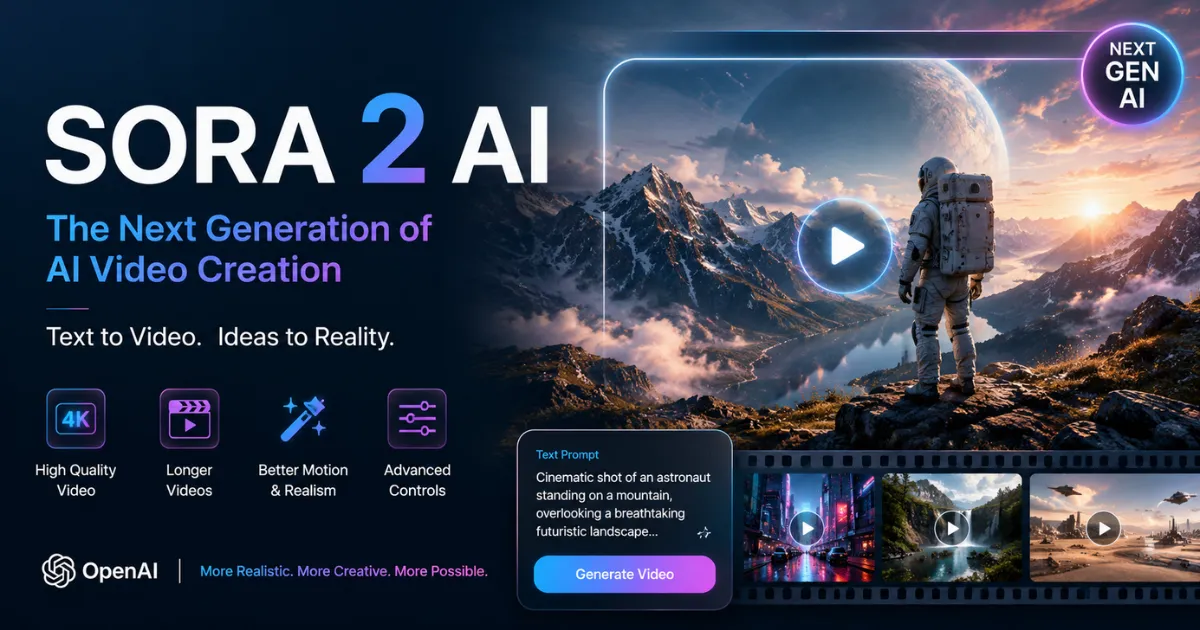
Longer, more coherent videos. Early AI video tools struggle to maintain consistency beyond a few seconds. Characters shift slightly between frames, backgrounds flicker, and scenes lose their internal logic. A more advanced model is expected to generate longer sequences — potentially several minutes — while keeping the visual narrative intact from start to finish.
Smoother motion and natural physics. One of the telltale signs of AI-generated video today is unnatural movement. Hair flows incorrectly, hands bend in impossible directions, and gravity seems to have its own mood. Improved training methods and larger datasets are expected to close this gap significantly.
Near-cinematic visual quality. As computational power increases and model architectures evolve, the sharpness, depth, and detail of AI-generated footage is expected to reach a quality level that rivals professionally shot video — at least for many common use cases.
Granular editing control. Perhaps the most practically useful upgrade for professional creators would be the ability to modify specific elements within a generated video — swap an object, adjust a camera angle, change the lighting mood — without regenerating the entire clip from scratch. This kind of targeted editing would make AI video tools far more useful in real production workflows.
Narrative intelligence. Generating a beautiful clip is one thing. Generating a clip that feels like it belongs to a larger story is another. Future models are expected to handle scene transitions, character continuity, and plot logic with greater sophistication — moving AI video from “impressive demo” to “actual storytelling tool.”
Who Stands to Benefit — and How
The potential audience for Sora 2 AI is remarkably broad, which is part of why interest in it has grown so quickly.
Independent content creators are perhaps the most obvious beneficiaries. Running a YouTube channel, newsletter, or social media account today often means wearing every hat — writer, editor, videographer, sound designer — simultaneously. AI video generation could dramatically compress the production timeline for creators who currently spend hours editing footage that takes minutes to describe.
Small and medium businesses that can’t afford video production agencies stand to gain access to a level of visual marketing content that was previously out of reach. Product showcases, brand storytelling videos, customer testimonials reconstructed from transcripts — all of this becomes potentially achievable without a dedicated production budget.
Educators and trainers working in online learning environments could use AI video tools to rapidly produce visual explanations, course materials, and scenario-based training modules. What now takes weeks to produce with a contractor could be turned around in an afternoon.
Filmmakers and creative studios could integrate these tools into their pre-production and prototyping workflows. Storyboarding, shot visualization, and quick concept testing could become faster and more iterative, freeing up human creative energy for the decisions that actually matter.
The Challenges That Can’t Be Ignored
It would be irresponsible to write about Sora 2 AI without spending time on the concerns that accompany it — not as an afterthought, but as a central part of the conversation.
Synthetic media and misinformation represent perhaps the most pressing issue. As AI-generated video becomes more realistic, so does its potential for misuse. Fabricated footage of public figures, misleading news content, and synthetic “evidence” in legal or political contexts are not hypothetical risks — they are problems that existing tools have already begun to create. More powerful video AI demands more robust detection and disclosure systems.
Copyright and training data remain deeply unresolved legal questions across the AI industry. The datasets used to train video generation models inevitably contain human-created work, and the legal frameworks for what counts as fair use in machine learning contexts are still being actively debated in courts around the world.
Labor displacement is a real concern for video professionals, motion graphics artists, animators, and production workers. While AI tools historically create new categories of work even as they automate existing tasks, the transition period for displaced workers is rarely smooth or equitable.
Content authenticity will require new norms and infrastructure. Watermarking, metadata tagging, and platform-level disclosure requirements are all being actively explored as potential responses — but adoption is uneven and enforcement is difficult.
None of these concerns make AI video generation a technology that should be slowed down arbitrarily. But they do mean that the companies building these systems, and the platforms distributing the content they enable, bear a significant responsibility to take governance seriously.
The Bigger Picture: Where Video AI Fits in the Evolving Creative Stack
Sora 2 AI doesn’t exist in isolation. It’s part of a larger convergence happening across text, image, audio, and video generation — a moment where the tools for creating multimedia content are being rebuilt from the ground up.
The most interesting creative work emerging from this period isn’t coming from people who treat AI as a replacement for human input. It’s coming from creators who understand how to use these tools as accelerants — doing in one hour what previously took ten, and spending the freed-up time on the decisions that require judgment, taste, and genuine originality.
That’s the real promise of Sora 2 AI: not a world where video makes itself, but a world where the distance between a creative idea and a finished visual product becomes short enough that more ideas actually get made.
The technology will continue to improve. The ethical conversations will continue to evolve. And the creators who engage thoughtfully with both — understanding the tools without being naive about their implications — will be the ones best positioned to use this moment well.