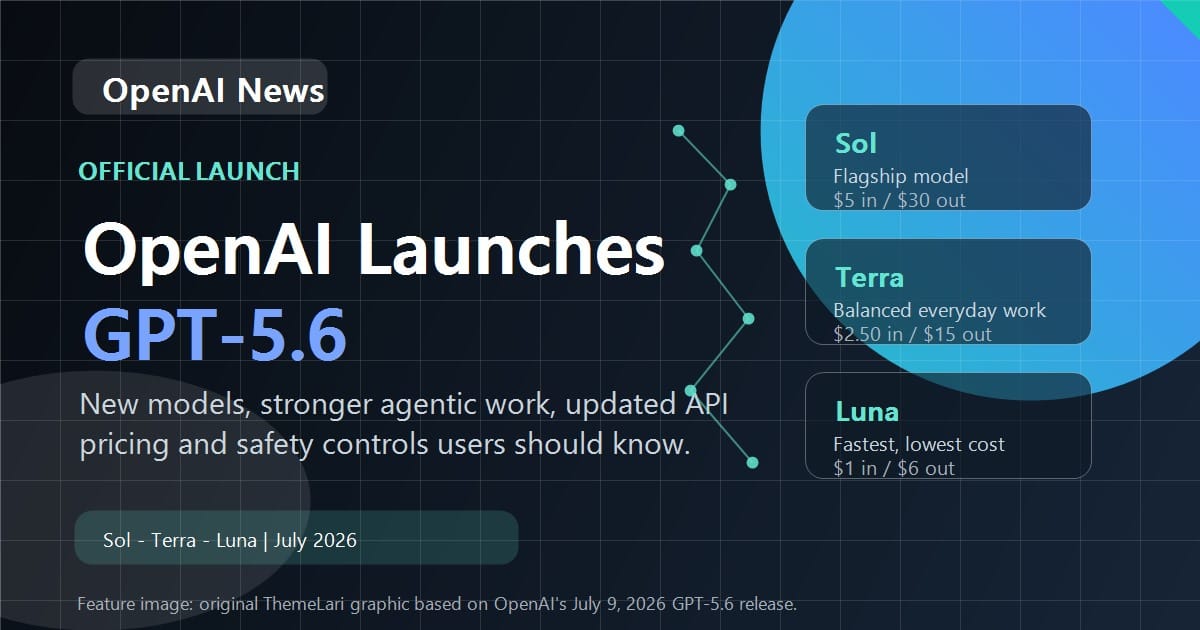
OpenAI Launches GPT-5.6 as its newest model family, bringing three model tiers, new agentic work features, updated API pricing and a broader rollout across ChatGPT, Codex and the OpenAI API. The July 9, 2026 release turns the earlier limited preview into general availability and gives users a clearer picture of how OpenAI wants to package frontier AI for daily work, developers and enterprise teams.
The launch matters because GPT-5.6 is not just a single model name. OpenAI is positioning the family as a practical lineup: Sol for the hardest tasks, Terra for balanced everyday work and Luna for speed and lower cost. For users, that means model choice may become less about one default chatbot and more about matching the right level of intelligence, latency and price to each job.
Source note: This article is based primarily on OpenAI’s official GPT-5.6 release page published on July 9, 2026, with background context from ThemeLari’s earlier coverage of the pre-launch U.S. review.
OpenAI Launches GPT-5.6 With Three Model Tiers
OpenAI says GPT-5.6 spans three durable capability tiers. Sol is the flagship model for the most demanding work. Terra is a lower-cost model aimed at everyday professional use. Luna is the fastest and most affordable option in the family. This tiered structure gives ChatGPT users and developers more flexibility than a one-size-fits-all upgrade.
For casual users, Luna may be enough for quick writing help, summaries and routine questions. Terra is likely to fit office tasks, coding help, research preparation and heavier document work. Sol is aimed at complex reasoning, agentic coding, cybersecurity, science and long-running professional workflows where accuracy, persistence and tool use matter more than raw speed.
What Is New in GPT-5.6?
The biggest change is efficiency. OpenAI says GPT-5.6 is trained to get more useful work from every token, which can reduce the number of model calls and output tokens needed for complex tasks. The company also highlights stronger coding, better computer use, improved design judgment and more reliable end-to-end knowledge work.
For developers, one of the most important additions is Programmatic Tool Calling in the Responses API. This lets GPT-5.6 write and run lightweight in-memory programs that coordinate tools, process intermediate results and keep only the useful information. In practice, that can make tool-heavy workflows cheaper and cleaner because the model does not need to pass every intermediate step back and forth.
OpenAI is also adding more capability controls. The max setting gives GPT-5.6 more time to reason, check and revise. The ultra setting goes further by coordinating multiple agents in parallel for demanding work. That makes GPT-5.6 more relevant for tasks such as codebase changes, research synthesis, financial analysis, document production and multi-step business operations.
GPT-5.6 Pricing: Sol, Terra and Luna
OpenAI lists GPT-5.6 API pricing per 1 million tokens. Sol costs $5 per 1M input tokens and $30 per 1M output tokens. Terra costs $2.50 input and $15 output. Luna costs $1 input and $6 output. The pricing makes Luna the high-volume option, Terra the balanced middle tier and Sol the premium model for the hardest jobs.
| GPT-5.6 model | Positioning | Input price | Output price |
|---|---|---|---|
| Sol | Flagship model for complex tasks | $5 / 1M tokens | $30 / 1M tokens |
| Terra | Balanced everyday work model | $2.50 / 1M tokens | $15 / 1M tokens |
| Luna | Fastest and most affordable model | $1 / 1M tokens | $6 / 1M tokens |
OpenAI also says GPT-5.6 brings more predictable prompt caching, including explicit cache breakpoints and a 30-minute minimum cache life. Cache writes are billed at 1.25 times the uncached input rate for GPT-5.6 and later models, while cache reads continue to receive a 90% cached-input discount. For companies with repeated prompts or long shared context, caching could be a major cost lever.
Where GPT-5.6 Is Available
OpenAI says GPT-5.6 is available across ChatGPT, Codex and the OpenAI API, with a global rollout continuing over 24 hours from the July 9 launch. In ChatGPT, Plus, Pro, Business and Enterprise users get access to GPT-5.6 Sol through medium and higher effort settings. Pro and Enterprise users can also select GPT-5.6 Sol Pro for the highest-quality results on complex tasks.
In ChatGPT Work and Codex, Free and Go users get access to GPT-5.6 Terra. Plus, Pro, Business and Enterprise users can choose between Sol, Terra and Luna and set effort levels. OpenAI says max is available to users with GPT-5.6 access in ChatGPT Work and Codex. Ultra is available to Pro and Enterprise users in ChatGPT Work and to Plus and higher plans in Codex.
Why GPT-5.6 Matters for ChatGPT Users
For everyday users, GPT-5.6 should feel most useful in long, messy tasks. That includes turning source material into a polished document, building an editable presentation, creating a spreadsheet, summarizing a set of files, planning a complex project or handling several steps with connected tools. OpenAI says GPT-5.6 improves knowledge work in documents, presentations and spreadsheets, which is where many users spend their workday.
It may also make ChatGPT feel more like a task partner than a simple Q&A box. Better computer use and tool coordination can help the model inspect results, revise outputs and continue working with less hand-holding. Users should still check important results, especially in legal, medical, financial or security contexts, but the practical value is clear: fewer restarts, fewer vague answers and more finished work.
Why Developers Should Pay Attention
Developers will care about three things: quality, cost and control. GPT-5.6 Sol is positioned as OpenAI’s strongest coding model, while Terra and Luna give teams lower-cost choices for high-volume workflows. Programmatic Tool Calling and multi-agent beta support in the Responses API could also change how developers build AI agents, because the model can coordinate more of the workflow inside a single request.
That does not mean every app should automatically move to Sol. For many production systems, Luna or Terra may be the better default because they can offer enough intelligence at a lower price. A sensible migration path is to route simpler work to Luna, everyday professional tasks to Terra and reserve Sol or ultra-style workflows for high-value tasks that justify the cost.
Safety and Cybersecurity Safeguards
OpenAI says GPT-5.6 launches with its most robust safeguards to date. The company says the models are more capable in biology and cybersecurity than earlier models but do not cross OpenAI’s Critical threshold in either category. In cybersecurity, OpenAI says GPT-5.6 is better at helping people find and fix vulnerabilities than reliably carrying out autonomous end-to-end attacks against hardened targets.
The company says it used layered safeguards, real-time checks, monitoring and account-level enforcement. It also says GPT-5.6 went through extensive red teaming, external expert testing and about 700,000 A100e GPU hours of automated red-teaming before general availability. That safety framing matters because advanced coding and cyber capabilities can be useful for defenders while also raising misuse concerns.
What Users Should Know Before Switching
First, GPT-5.6 availability may depend on plan, product and rollout timing. A user may see Sol in one OpenAI product but Terra or Luna in another. Second, the best model is not always the biggest one. A cheaper model may be better for fast drafts, quick summaries and high-volume automation. Third, new safeguards may sometimes add friction around sensitive cyber or dual-use requests.
For businesses, the launch is a reminder to review AI budgets. Output tokens remain much more expensive than input tokens, so teams should watch long generated responses, repeated tool calls and poorly cached prompts. The new pricing makes GPT-5.6 powerful, but cost discipline still matters.
Bottom Line
OpenAI Launches GPT-5.6 at a moment when users expect AI to do more than answer questions. The model family is built around practical choice: Sol for frontier performance, Terra for balanced daily work and Luna for fast low-cost usage. The most important updates are not only benchmark gains, but the workflow features around agents, tools, caching and safety.
For ChatGPT users, GPT-5.6 could make complex work smoother. For developers, it opens a more flexible model stack. For enterprises, it raises the familiar question of performance versus cost. The smart move is to test all three tiers, measure real task outcomes and choose the smallest model that reliably gets the job done.
FAQ
What is the focus keyword for this article?
The focus keyword is OpenAI Launches GPT-5.6.
When did OpenAI launch GPT-5.6?
OpenAI published its GPT-5.6 general availability release on July 9, 2026.
What are the GPT-5.6 models?
The GPT-5.6 family includes Sol, Terra and Luna. Sol is the flagship model, Terra is the balanced model and Luna is the fastest, lowest-cost tier.
How much does GPT-5.6 cost in the API?
OpenAI lists Sol at $5 input and $30 output per 1 million tokens, Terra at $2.50 input and $15 output, and Luna at $1 input and $6 output.
Sources: OpenAI GPT-5.6 release page; ThemeLari background coverage on the GPT-5.6 launch review.