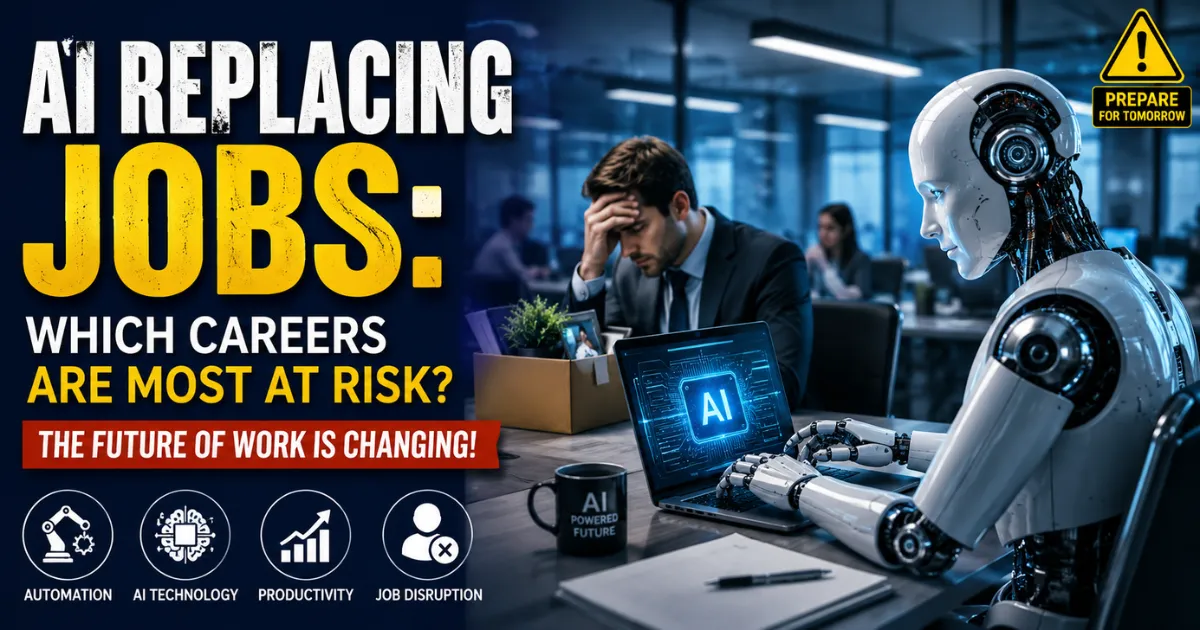
The machines aren’t coming. In many ways, they’re already here.
AI Replacing Jobs : Across industries worldwide, artificial intelligence is quietly reshaping how work gets done. Factories are running leaner. Customer calls are being answered by bots. Invoices are processing themselves. And for millions of workers, the question is no longer abstract: Will AI take my job?
The honest answer? It depends on what you do — and how willing you are to change.
AI Replacing Jobs: The Shift That’s Already Underway
AI doesn’t get tired. It doesn’t take lunch breaks. It doesn’t ask for a raise. For businesses operating on tight margins, that’s an irresistible pitch. And so, quietly but steadily, companies are replacing routine human tasks with software that does them faster, cheaper, and around the clock.
This isn’t the robotic apocalypse that science fiction warned us about. It’s more subtle than that. It’s a spreadsheet that fills itself. A chatbot that handles your complaint before a human ever sees it. A voice on the phone that never existed.
But the effects are very real for the people on the other end.
The Professions Feeling the Pressure
Data entry clerks are among the first to feel it. Modern AI can scan a document, extract information, and push it into a database without a single human keystroke. What once required a team now takes seconds. Workers in this space who haven’t diversified their skills are finding fewer and fewer openings.
Customer service representatives are next in line. AI chatbots now handle order tracking, refund requests, and basic troubleshooting with surprising competence. Most customers don’t even realize they’re not talking to a person. Human agents still handle the complicated stuff — the angry callers, the edge cases, the situations that require judgment — but the volume of work flowing to them is shrinking.
Telemarketers face perhaps the steepest climb. Automated voice systems can dial thousands of numbers a day, follow scripts, respond to basic questions, and log outcomes — all without a commission structure. It’s not hard to see where that’s heading.
Content writers occupy more complicated territory. AI can churn out product descriptions and generic blog posts at scale. But it can’t interview a source. It can’t build an argument from lived experience. It can’t earn a reader’s trust over time. Writers who compete on volume alone may struggle; those who lead with expertise, voice, and original insight have ground to stand on.
Bookkeepers and basic accounting staff are watching their core tasks get absorbed by software. Expense categorization, report generation, error-flagging — tools like QuickBooks and newer AI platforms handle these with minimal human involvement. That said, strategic financial advising, tax planning, and audit work remain firmly in human territory.
Retail cashiers are being replaced gradually — not all at once, but noticeably. Self-checkout lanes are no longer a novelty. In some stores, they’re the default. Workers who pivot toward customer experience, floor management, or sales are better positioned than those who stay in transactional roles.
Assembly line and manufacturing workers have lived with this reality the longest. Industrial robots have been a fixture in factories for decades. What’s new is the intelligence layer — AI systems that can spot defects, adjust production in real time, and optimize output without human direction. Blue-collar work isn’t disappearing, but it’s evolving toward roles that require technical know-how rather than physical repetition.
Where Humans Still Win
For all its capability, AI has clear limits. It can process patterns. It cannot build relationships. It can generate text. It cannot exercise conscience.
That’s why certain careers remain largely insulated — for now and the foreseeable future.
Healthcare professionals, teachers, psychologists, skilled tradespeople, researchers, and creative leaders all depend on qualities that don’t translate neatly into code. Empathy. Judgment. The ability to sit with someone in a moment of crisis and say the right thing. Those aren’t features you can train a model on.
The Skills That Will Define the Next Decade
The workers who will thrive aren’t necessarily the ones with the most technical expertise. They’re the ones who know how to think.
Critical thinking — the ability to break down a problem that doesn’t have a clean answer — is growing more valuable as routine tasks disappear. Communication and relationship-building matter more when machines are handling logistics. Creativity drives the ideas that automation can only execute, never originate.
Perhaps most importantly: digital literacy. You don’t need to write code. But you do need to understand what these tools can and can’t do, and how to direct them effectively. The worker who knows how to use AI well will consistently outperform the one who ignores it — and both will outperform the one trying to compete against it directly.
Yes, New Jobs Are Coming
History offers some reassurance here. The internet wiped out entire categories of work — travel agents, video rental clerks, classified ad departments — and then created industries that no one had imagined. The same pattern is unfolding again.
Roles like AI trainer, prompt engineer, machine learning specialist, automation consultant, and AI ethics professional barely existed a few years ago. Today, they’re among the fastest-growing positions in the technology sector. A decade from now, the landscape will look different still.
The Bottom Line
The conversation about AI and employment isn’t really about replacement. It’s about transition — who manages it well, and who gets left behind.
Careers built on repetitive, predictable tasks are under genuine pressure. That’s not alarmism; it’s where the data points. But the solution isn’t to unplug from the future. It’s to stay ahead of it — to keep learning, keep adapting, and keep developing the skills that machines, for all their power, still can’t replicate.
Technology is changing what work looks like. It hasn’t changed why people matter.