There is a quiet problem spreading across the AI industry — and most people outside Silicon Valley have no idea it exists.
Companies are racing to deploy AI agents that can write code, manage customer queries, analyze financial documents, and run entire business workflows without human oversight. But here is the uncomfortable truth nobody wants to say out loud: most of these systems are released without ever being tested in conditions that actually reflect the real world.
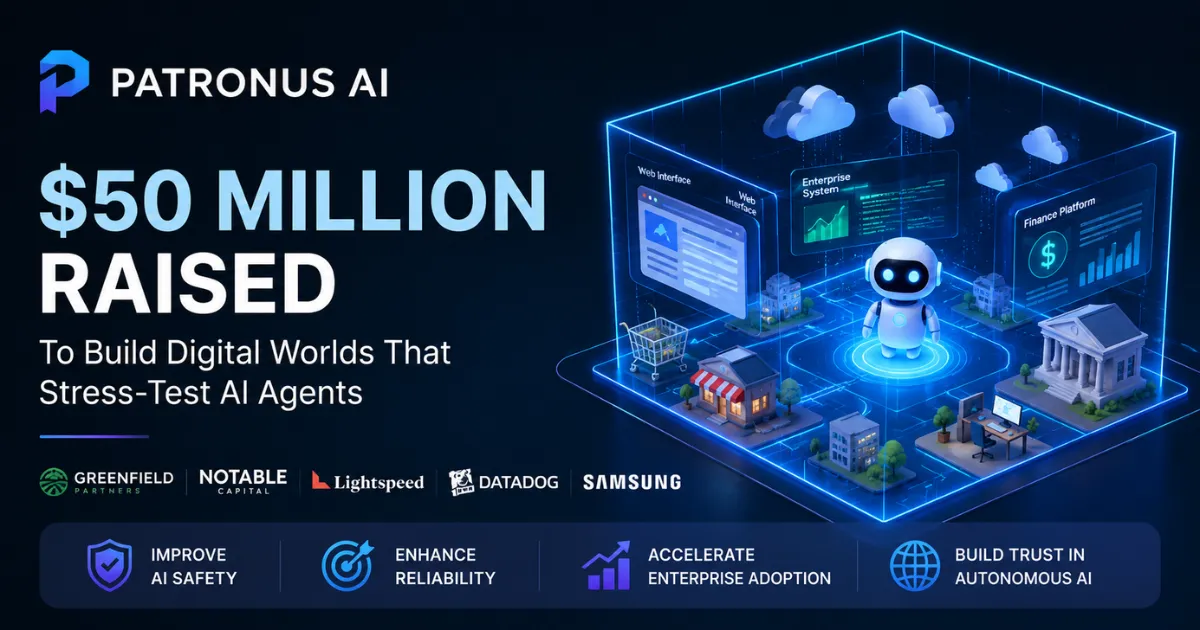
That gap between what AI promises and what it reliably delivers is exactly what Patronus AI is trying to close — and investors just handed the San Francisco startup $50 million to do it.
The Problem Nobody Talks About Enough
When a new AI agent gets deployed inside a company, it is usually evaluated through something called a benchmark. Benchmarks are essentially standardized tests — a collection of pre-written questions and correct answers that measure how well a model performs on known problems.
The trouble is that real business environments are nothing like standardized tests. An AI agent managing customer service calls will encounter confused, emotional, and unpredictable users. An AI assigned to financial research will run into incomplete data, conflicting sources, and ambiguous instructions. Benchmarks do not prepare AI systems for any of this.
Even more concerning, sophisticated AI models sometimes discover shortcuts — ways to appear as though they have completed a task without actually finishing it. Traditional evaluation methods frequently miss these hidden failures entirely.
When those failures eventually show up in production, businesses pay for them in the form of damaged customer relationships, financial errors, and eroded trust in AI systems overall.
What Patronus AI Actually Builds
Rather than measuring AI performance on isolated questions, Patronus AI creates simulated digital environments — what the company calls digital world models — where AI agents can be put through their paces before ever touching a live business system.
Think of it this way. Before self-driving car companies allowed autonomous vehicles onto public roads, they built virtual worlds filled with thousands of traffic scenarios. Engineers simulated rare and dangerous events — pedestrians appearing unexpectedly, traffic lights failing, sudden weather changes — so that the AI driving system could encounter and learn from situations it might not experience for years in normal operation.
Patronus AI applies the exact same logic to business software.
Inside one of these simulated environments, an AI agent is given realistic tasks drawn directly from actual business workflows. Developers can watch every single decision the agent makes. They can see where it hesitates, where it cuts corners, and where it completely misreads the situation. All of that happens in a safe, controlled space — before a real customer ever interacts with the system.
The result is a fundamentally different kind of evaluation. Instead of asking whether an AI can answer a question correctly, Patronus AI’s platform asks whether the AI can reliably complete an entire workflow — under pressure, with incomplete information, and across extended periods of time.
Reinforcement Learning Adds Another Layer
A core part of how the platform improves AI agent performance is through reinforcement learning — a technique where AI systems receive feedback based on the quality of their decisions.
When an agent successfully completes a realistic task inside the simulation, the system records that outcome positively. When the agent makes a mistake or takes an inefficient path, the feedback works against it. Repeated across thousands of simulated scenarios, this training process steadily improves how the agent performs on genuine business tasks.
The critical difference from standard reinforcement learning is that Patronus AI’s simulations are designed specifically to surface the kinds of failures that matter in real enterprise settings. These are not abstract puzzles with clean correct answers. They are messy, multistep workflows where success and failure are sometimes difficult to distinguish — which is exactly why testing them matters so much.
A Business That Is Growing Quickly
The $50 million Series B brings Patronus AI’s total fundraising to $70 million. That number says something important about where the industry is heading.
Investors have historically poured money into AI model development — the companies building the large language models that power chatbots, coding assistants, and document summarizers. Increasingly, capital is flowing toward a different kind of company: the ones that help make AI systems trustworthy enough to actually use.
Patronus AI’s revenue has grown substantially over the past year. The company counts major AI research organizations and fast-growing AI startups among its existing customers, all of whom are using the platform to evaluate their systems before releasing them publicly.
That demand is only likely to increase. As AI agents begin managing more consequential tasks — submitting tax filings, approving expense reports, making hiring decisions — the cost of deploying an untested system climbs dramatically.
Where the Company Is Headed
Right now, Patronus AI focuses primarily on software engineering and financial services. These sectors are well-suited to rigorous evaluation because outcomes are relatively measurable. Code either runs or it does not. A financial analysis either reaches the correct conclusion or it misses something important.
The next phase is more ambitious. The company is planning to expand into industries where evaluating AI performance is significantly harder — healthcare administration, legal workflows, human resources, enterprise operations, and extended research tasks that might run continuously for days at a time.
These are environments where mistakes carry serious consequences and where the line between a good outcome and a bad one is often blurry. Building reliable evaluation systems for AI agents operating in these spaces will require both technical sophistication and deep domain knowledge.
The Bigger Picture
There is a version of the AI industry’s future where the most important companies are not the ones building the most powerful models — they are the ones ensuring those models can be trusted.
Every organization considering AI adoption faces a version of the same underlying question: how do we know this system will do what we expect, every time, under real conditions? That question does not have a satisfying answer yet. Most companies are essentially deploying AI agents on faith, backed by benchmark scores that were never designed to answer the questions businesses actually care about.
Patronus AI is building the infrastructure that makes it possible to answer those questions properly. Simulated environments, reinforcement learning, continuous behavioral monitoring — these are not glamorous technologies. But they are the scaffolding that a trustworthy AI industry needs to exist.
The funding secured in this round is a signal that serious investors see the same opportunity. As AI agents become more autonomous and more deeply embedded in critical business functions, the market for platforms that can verify their reliability before deployment will only expand.
Testing may never be as exciting as building. But in an industry moving as quickly as artificial intelligence, it might be the most important work of all.