Google Frozen v2 AI chip is reportedly being designed to make Gemini faster, more efficient, and easier to run at global scale.
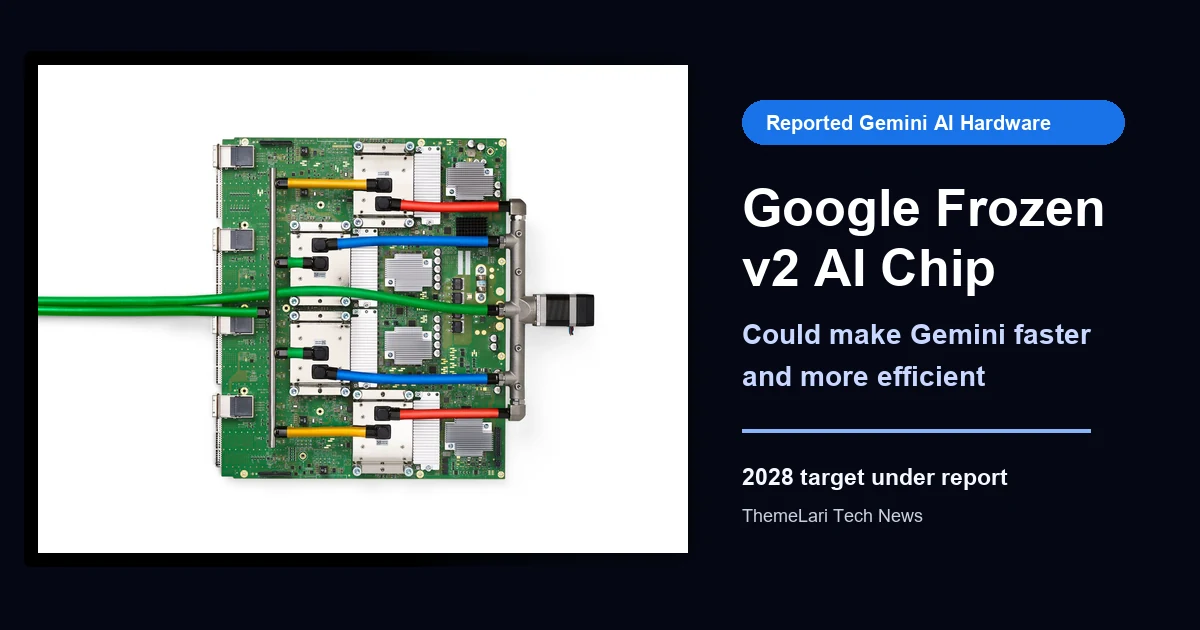
Google is reportedly preparing a new server processor that could change how Gemini answers millions of AI requests. The Google Frozen v2 AI chip, according to reports citing The Information, would place selected parts of Gemini’s model architecture directly into silicon. If the plan reaches production, Google could use the chip as early as 2028 to make Gemini faster, cheaper to operate, and less hungry for electricity.
The story matters because AI is no longer only a battle of chatbots and benchmarks. Behind every Gemini response is a huge stack of chips, memory, networks, cooling systems, and power. A model that feels instant to users can be very expensive to run at global scale. That is why a more efficient chip could become as important as the next model upgrade.
What Is the Google Frozen v2 AI Chip?
The reported Google Frozen v2 AI chip is described as a custom server chip for Gemini inference. Inference is the phase where a trained AI model produces an answer, summarizes a document, writes code, reads an image, or completes a task for a user. It happens repeatedly, all day, across consumer products and cloud services.
Instead of acting like a flexible processor that can run almost anything, Frozen v2 is said to be more tightly shaped around Gemini itself. Reports say engineers are studying how much of Gemini’s architecture should be built into the chip while keeping model weights updateable. That detail is important: if too much is fixed in hardware, the processor could age quickly as Gemini changes.
Why Google Wants a More Efficient Gemini Engine
Google already designs its own AI accelerators, known as Tensor Processing Units, or TPUs. These chips help power Google products and Google Cloud workloads. But demand for AI compute has grown so sharply that even large cloud companies are under pressure to squeeze more output from every watt of electricity and every rack of hardware.
Reuters, citing The Information, reported that Frozen v2 is intended to help with an AI computing capacity shortage and could reduce pressure on Google Cloud. The same report said the chip may target six to ten times better efficiency than Google’s latest custom AI chips when measured by AI tokens served per unit of energy. That number should be treated as a target from a project in development, not as a finished product claim.
How Frozen v2 Is Different From TPUs
Frozen v2 is not being described as a replacement for Google’s TPUs. The reported plan is to create a separate in-house chip family that can sit beside TPUs. That gives Google a layered strategy: TPUs for broad training and inference work, Nvidia GPUs for customer needs and flexible workloads, and potentially Frozen chips for highly optimized Gemini serving.
This fits the direction Google announced at Cloud Next 26. Google introduced TPU 8t for large-scale training and TPU 8i for low-latency inference and reasoning. The company said TPU 8i improves on-chip memory and interconnect performance for agentic AI, while TPU 8t is built for massive training scale. Frozen v2 would push specialization even further by tying hardware more closely to Gemini’s architecture.
What It Could Mean for Gemini Users
For everyday users, the biggest changes would be invisible but noticeable. A more efficient Gemini backend could mean quicker replies, better availability during busy periods, and more room for advanced features such as longer context, multimodal reasoning, coding help, and AI agents that carry out several steps before returning an answer.
Efficiency also affects price. If Google can serve more tokens with the same energy and hardware budget, it may have more flexibility in how it packages Gemini features for free users, paid subscribers, Workspace customers, and developers using APIs. The benefit would not automatically show up as lower prices, but it could reduce the infrastructure pressure behind every product decision.
The Nvidia Question
Any new Google AI chip naturally raises the Nvidia question. Nvidia GPUs remain central to the AI boom, and Google Cloud still offers Nvidia-based infrastructure. Google has also said it will bring systems based on Nvidia’s Vera Rubin platform to customers. So Frozen v2 should not be read as a simple replacement story.
A more realistic picture is mixed hardware. Google can use its own TPUs where they make sense, offer Nvidia GPUs where customers want them, and test Frozen v2 for Gemini-specific workloads. That gives the company more control over cost and capacity while still participating in the wider AI hardware market.
Why the 2028 Timing Matters
The reported 2028 deployment window shows how difficult AI hardware planning has become. Software models can change in months, but chips take years to design, manufacture, test, and deploy. Google must decide what parts of Gemini are stable enough to put into silicon before the final Gemini versions of 2028 even exist.
That is the central risk of the Google Frozen v2 AI chip. The tighter the connection between model and hardware, the bigger the efficiency gain can be. But the tighter the connection, the less flexible the chip may become if Gemini’s architecture changes faster than expected. Google appears to be searching for the right balance between speed, energy savings, and long-term usefulness.
Why This Chip Story Is Bigger Than One Processor
Frozen v2 points to a larger shift in the AI race. The winners will not only be the companies with smart models. They will also be the companies that can run those models reliably, affordably, and at huge scale. Data centers, custom chips, memory systems, networking, and power management are becoming part of the product experience, even when users never see them.
For Google, that full-stack advantage has always been a selling point. It builds models, cloud services, search products, mobile software, and AI hardware under one roof. If Frozen v2 works, it could strengthen that advantage by making Gemini less dependent on general-purpose acceleration and more tuned to Google’s own infrastructure.
Another quiet factor is trust. If Gemini can answer quickly without visible slowdowns, users are more likely to rely on it for daily work. But Google will still need transparency around privacy, safety, and accuracy. Faster hardware helps delivery, while careful model behavior decides whether people keep coming back in competitive consumer and cloud products today worldwide.
Bottom Line
For now, the Google Frozen v2 AI chip remains a reported development project, not an official product launch. The design, performance targets, and 2028 timing could all change. Still, the idea is important: Google is reportedly exploring a chip that bakes parts of Gemini’s architecture into hardware so the model can run with better speed and energy efficiency.
If the project succeeds, most users may never know when a Frozen chip is serving their Gemini request. They may simply notice that AI tools feel faster, more available, and capable of doing more. In the next stage of AI competition, that quiet improvement behind the screen could matter just as much as the model name on the screen.
Sources: Reuters via UOL, Google Cloud AI infrastructure at Next 26, Google TPUs 8t and 8i, Tom’s Hardware Frozen v2 report.