Substack is giving readers a new way to question what they are reading online. The company has introduced a feature called “Scan for AI text,” a built-in tool that estimates whether a post, Note, comment or reply appears to be written by a person or assisted by artificial intelligence.
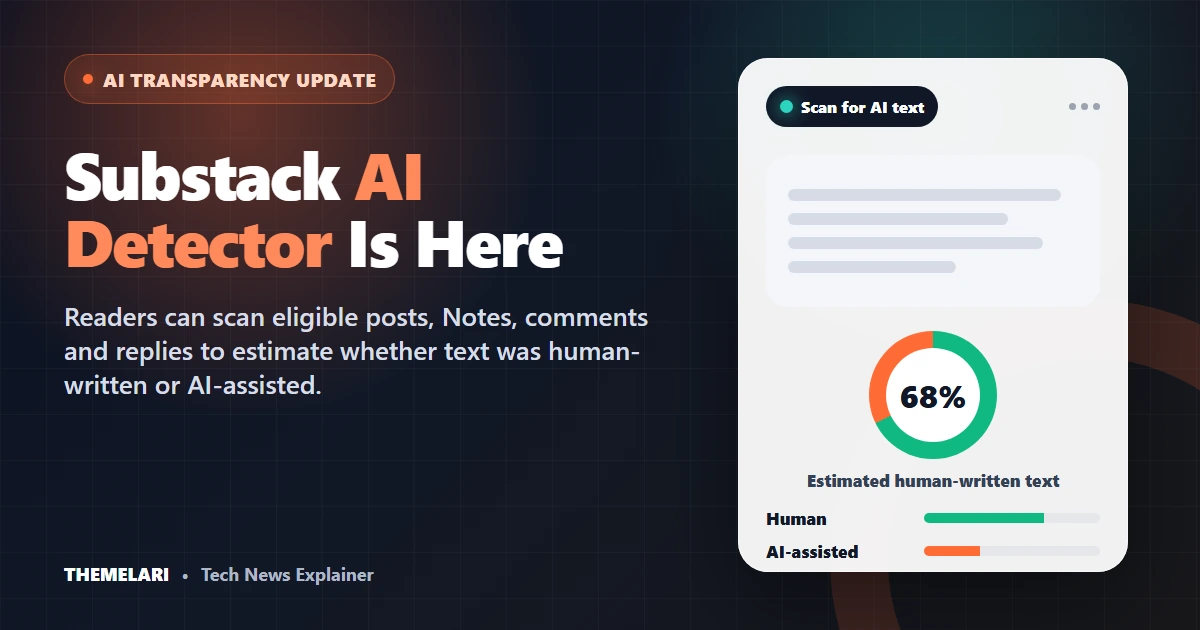
The new Substack AI Detector is powered by Pangram, an AI-detection company. It does not simply stamp a post as “human” or “AI.” Instead, it returns a percentage-style estimate showing how much of the text appears human-written or AI-assisted.
That distinction matters. Substack is not saying the tool can prove exactly how every sentence was created. It is presenting the scan as a transparency signal, not a final verdict.
According to Substack’s support page, the feature works on eligible posts and Notes published on or after July 21, 2026. It is available in supported Substack reading surfaces, including Substack Reader on the web and the iOS app, with support varying by content type and platform.
What Is the Substack AI Detector?
The Substack AI Detector is a reader-facing tool designed to estimate whether a piece of text looks human-written or AI-assisted.
Readers can use it from the menu attached to supported content. On the web, a reader opens an eligible post inside Substack Reader, clicks the three-dot menu and chooses “Scan for AI text.” Pangram then analyzes the text and shows an estimate.
The feature also applies to Substack Notes, individual comments and replies where enough text is available for analysis. Very short pieces may not have enough language for the detector to review, so readers may see a message saying there is not enough text.
For newsletter readers, the change is small on the surface but important in practice. It puts authorship directly into the reading experience.
Where the Tool Works
The scan does not appear everywhere on Substack.
Substack says the feature is available for supported written content opened through Substack Reader and eligible app surfaces. It does not work for video or audio posts. It also does not apply when someone is reading a newsletter by email, on a standalone Substack site or on a custom domain.
That means a reader may need to open a post inside Substack Reader to see the scan option. If the option is missing, it does not automatically mean anything suspicious. The content may simply be outside the supported area.
Why Substack Is Adding AI Detection
AI tools have changed online publishing quickly. Writers can use them for outlines, edits, summaries, translations or full drafts. Some creators use AI lightly and responsibly. Others may publish large volumes of machine-generated text with little original input.
That difference matters most when readers are paying for a direct relationship with a writer.
A subscriber usually expects a newsletter to carry the writer’s judgment, voice, reporting or experience. If the content is mostly automated, readers may feel misled, especially when the publication is marketed as personal work.
Substack’s new detector does not ban AI. It gives readers another clue about how a piece may have been produced.
Writers Can Add Their Own Explanation
Substack is also giving creators a way to explain their process through a statement called “How I make this.”
A writer can use that space to describe whether AI is part of their workflow. For example, a journalist might say they use AI only for transcription or grammar checks. A newsletter creator might explain that AI helps organize research notes, while the reporting and final writing are done manually.
This creator statement may be more useful than a percentage alone. A detector can examine text patterns, but it cannot see the interviews, research, edits, lived experience or judgment behind the finished piece.
For readers, the best signal may come from both parts together: the automated estimate and the writer’s own explanation.
Creators Can Disable Detection
Substack also allows writers to disable AI detection on individual draft posts or Notes.
If detection is disabled, readers will see that the scan is unavailable for that content instead of receiving a Pangram score. This control is likely to create debate. Some readers may see a disabled scan as a warning sign, while some writers may disable it because they worry about false positives or automated judgment.
The important point is that a missing scan does not prove AI use. In the same way, a high AI-assisted estimate should not be treated as absolute proof of dishonesty.
Substack also provides a way to report detection errors, which can help improve the system over time.
AI Detection Still Has Limits
AI detection is difficult because writing is not a perfect fingerprint.
A careful human writer can produce clean, structured, predictable prose. AI-generated writing can also be edited, rewritten and personalized until it sounds more natural. A detector only sees the final text. It does not watch the creative process.
That is why the Substack AI Detector should be treated as one signal among many.
Readers should still ask broader questions. Does the article contain original reporting? Does it include personal experience, clear reasoning, credible sources and useful analysis? Does the writer communicate honestly with the audience?
Those signs often say more about quality than a single percentage.
What This Means for Readers
For readers, the new feature may be useful when a post feels generic, repetitive or unusually polished in a way that lacks a clear human point of view.
It could also help before someone pays for a newsletter subscription. If a publication promises personal insight but appears to rely heavily on automated text, readers may want to ask more questions before subscribing.
At the same time, the tool should not become a weapon against writers. AI assistance can mean many different things. There is a big difference between using software to clean up a typo and publishing an article that was almost entirely machine-generated.
The real issue is transparency.
A Bigger Moment for Online Publishing
The launch of the Substack AI Detector shows where digital publishing is heading. Readers want to know whether the work they support reflects human thought, automated production or some mix of both.
Substack’s answer is not perfect, but it is a clear step toward making authorship more visible.
The most useful outcome may not be a race for perfect “human-written” scores. It may be a culture where creators explain their methods clearly, readers judge work with context and platforms give people better tools to understand what they are reading.
For now, the Substack AI Detector gives readers one more way to evaluate trust in a publishing world where the line between human and machine-made text is getting harder to see.
Sources: Substack Support, The Verge, Pangram