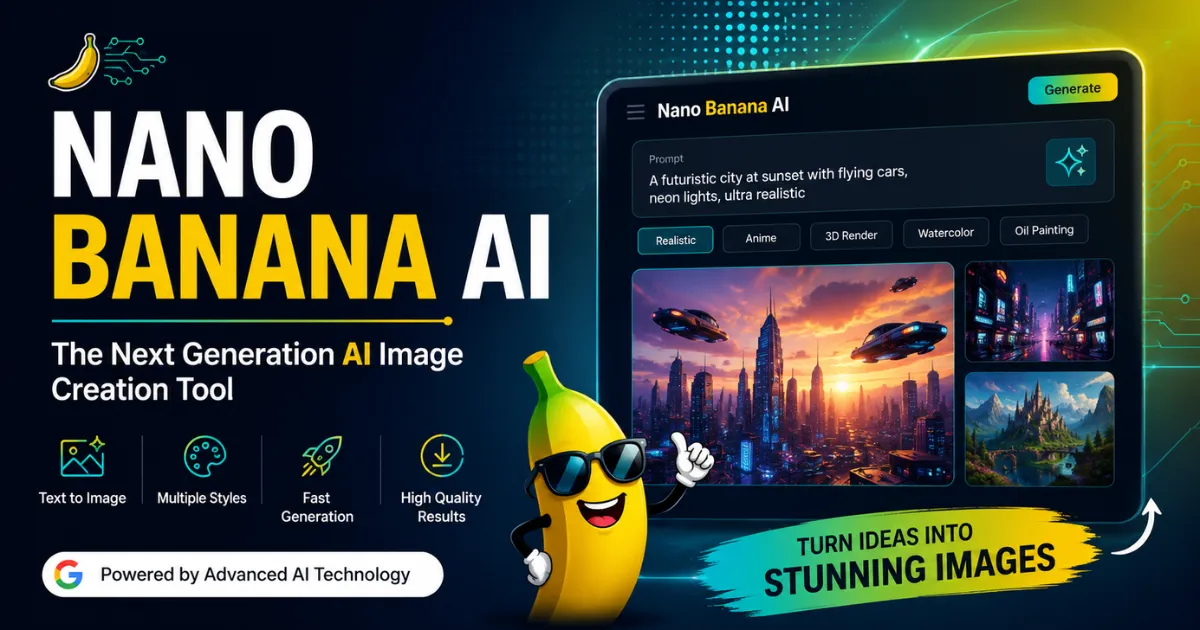
There’s a new tool circulating in creator circles, and it’s generating more than just images — it’s generating genuine curiosity. Nano Banana AI has quietly built a following among bloggers, marketers, and small business owners who are tired of fighting with expensive design software or paying premium rates for every piece of visual content they need.
It doesn’t come with a lot of fanfare. No celebrity endorsements, no massive launch campaign. Just word of mouth from people who tried it and kept coming back.
So what’s the story behind Nano Banana AI, and does it actually deliver?
The Idea Behind Nano Banana AI Is Almost Embarrassingly Simple
You describe what you want. The AI makes it.
That’s the pitch, and honestly, it works better than it sounds. Nano Banana AI is built around text-to-image generation — you type a prompt describing a scene, a mood, a concept, and the platform produces a finished visual in seconds. No templates to wrestle with. No layers to manage. No tutorials to sit through before you can produce something usable.
For someone who publishes content regularly — three blog posts a week, daily social media, weekly newsletters — that kind of immediacy is not a small thing. It removes a bottleneck that slows most independent creators down more than they realize.
What Makes Nano Banana AI Different From Everything Else Out There
The AI image generation market is crowded. There are dozens of tools making nearly identical promises, which makes it fair to ask why Nano Banana AI is the one people are actually talking about right now.
Part of the answer is how the tool handles style. Most image generators have a signature look — outputs tend to feel like they all came from the same visual DNA. Nano Banana AI gives users more meaningful control over the final aesthetic. Realistic photography, watercolor, anime, oil painting, 3D render, vintage illustration — the range is genuinely varied, not just cosmetic. That matters when you’re trying to match a specific brand voice or content style rather than just generating something generic.
The other part is prompt understanding. Nano Banana AI reads nuanced descriptions reasonably well. Tell it you want a Tokyo street scene at 2am in the rain, shot from a low angle with neon reflections on wet pavement, and it produces something that actually reflects that rather than a vague approximation of “city at night.”
The People Who Are Getting Real Use Out of Nano Banana AI
Walk through the actual user base and the pattern becomes clear. Nano Banana AI isn’t primarily a tool for experimental artists or AI hobbyists — it’s being used by people with practical, recurring visual content needs.
Bloggers reach for it when they need a featured image that doesn’t look like recycled stock. Social media managers use it to stay ahead of content calendars without burning hours in design software. Teachers generate concept illustrations for students who learn better with visuals. Small shop owners build promotional graphics without hiring an agency.
What they share is a need for volume and speed without sacrificing quality. Nano Banana AI fits that gap in a way that most tools in this space don’t.
Getting the Most Out of Nano Banana AI Takes a Little Practice
There’s a learning curve here, but it’s not a technical one. The tool itself is straightforward. The challenge is learning how to communicate your vision clearly enough for the AI to execute it well.
Vague prompts are the most common mistake new users make. “A nature scene” will produce something forgettable. “A fog-covered pine forest in early morning light, with a narrow dirt path disappearing into the mist, soft blue tones, cinematic mood” will produce something worth using.
Lighting is one of the most underused elements in prompts. Mentioning whether a scene is lit by sunlight, candlelight, neon signs, or overcast sky changes the entire character of the output. Color palette, background detail, camera distance — all of it shapes what Nano Banana AI produces. The more deliberate you are in your description, the less time you spend regenerating images that almost hit the mark.
Most experienced users treat the first result as a draft. Two or three iterations usually gets you to something you’d actually publish.
Does Nano Banana AI Help With SEO? The Real Answer
Marketers ask this constantly, and the answer is more nuanced than a simple yes or no.
Nano Banana AI-generated images can improve how a post performs — but not because of anything the image itself does algorithmically. The benefit is behavioral. A post with a strong, relevant visual keeps readers engaged longer, signals to search engines that the content is worth showing to others, and reduces the kind of quick bounce rates that quietly tank rankings over time.
The optimization work still has to happen on your end. File names should describe what the image actually shows. Alt text should be written for a human reader, not stuffed with keywords. File sizes need to be compressed before upload, because slow-loading images cost you ranking position regardless of how good they look. And the images need to be genuinely relevant — Nano Banana AI is useful precisely because it lets you generate visuals specific to your actual content, not just grab something adjacent from a stock library.
That specificity is what makes the SEO case for Nano Banana AI genuine rather than just theoretical.
Where Nano Banana AI Runs Into Trouble
It would be dishonest to leave out the limitations, and they’re real.
Crowd scenes and complex compositions with multiple specific characters are where the tool struggles most consistently. Hands remain a persistent problem across AI image generators, and Nano Banana AI is no exception. Any time you need legible text inside an image — a sign, a label, a headline on a banner — expect the output to get it wrong. That’s not a Nano Banana AI problem specifically; it’s an industry-wide weakness that hasn’t been fully solved yet.
Complex branding work — anything that requires tight consistency across dozens of assets with specific color codes, typography, and visual rules — still needs a human designer. Nano Banana AI can support that process, but it can’t replace the strategic thinking behind it.
And like most AI tools worth using, the best features come with a subscription. The free tier will show you what the tool can do; it won’t give you full access to what makes it worth using.
What Nano Banana AI Is Building Toward
The current version is an image generator. The version being developed is something broader.
The roadmap for Nano Banana AI includes AI video generation, real-time editing capabilities, voice-to-image creation, and improved character and brand consistency across multiple outputs. If those features land the way they’re described, the tool shifts from a content asset creator to a full visual content workflow.
That’s a meaningful jump. Whether the execution matches the ambition will determine whether Nano Banana AI becomes a long-term standard in the industry or just another tool people cycle through.
The Bottom Line on Nano Banana AI
Here’s the honest summary: Nano Banana AI is a practical, well-executed tool that solves a real problem for a specific type of creator.
If you publish content at any real volume, you know how much time and money visual production costs. Nano Banana AI doesn’t eliminate that cost, but it brings it down to a level that’s actually manageable for individuals and small teams. The quality is good enough for most publishing contexts. The interface doesn’t require a learning period. The style variety is broad enough to be genuinely useful rather than just technically diverse on paper.
It won’t make decisions for you. It won’t replace the instincts of a skilled creative director. But it will give you a polished image in the time it takes to write a sentence — and for a lot of creators, that changes what’s actually possible in a workday.