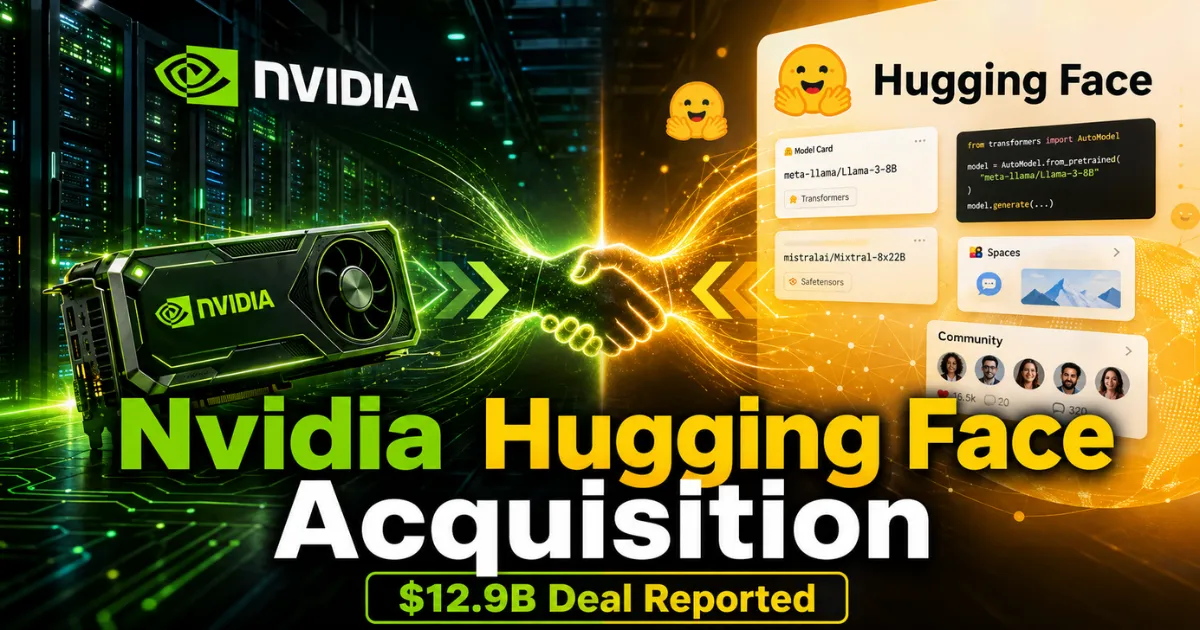
Nvidia Hugging Face acquisition : Nvidia is said to be placing one of its largest bets so far on the future of artificial intelligence.
A report quoted by Reuters on August 27 states that the giant in the field of AI chips has agreed to buy Hugging Face for $12.9 billion. Once completed, the transaction would place one of the most influential open-source AI platforms under the control of the company which already holds a dominant position in much of the hardware that is driving the current AI boom.
The timing of the reported acquisition by Nvidia is highly significant for the AI industry. Nvidia has established an impressive business by selling GPUs and data-centre systems to companies that are involved in the development of artificial intelligence. At the same time, Hugging Face has become a central point where developers, researchers and companies using open and open-weight AI models come together.
Combining those two businesses could enable Nvidia to take on a much greater role in what occurs after the chips have been installed—for example, in locating AI models as well as in building, testing and deploying them.
Nvidia reportedly agrees to buy Hugging Face for $12.9 billion
The Information first reported that Nvidia had agreed to buy Hugging Face for approximately $12.9 billion, with Reuters subsequently reporting the deal.
The purchase price is striking because Hugging Face was valued at about $4.5 billion in a $235 million funding round in 2023, a round that included Nvidia among its investors. Reuters reports that the new acquisition price would make the transaction one of Nvidia’s largest deals.
The reported agreement therefore values Hugging Face at nearly three times its 2023 private-market valuation.
Neither Nvidia’s recent public blog updates nor Hugging Face’s public site showed a formal acquisition announcement at the time this article was prepared. That is why the transaction should still be described as reported rather than presented as a completed acquisition.
Why does Nvidia want Hugging Face?
At first glance, Nvidia and Hugging Face operate in very different parts of the AI market.
Nvidia is best known for the GPUs and computing infrastructure used to train and run AI systems. Hugging Face built its reputation around software, developer tools and a widely used hub where developers can discover, share and work with AI models and datasets.
That difference is exactly what makes the reported deal interesting.
For years, Nvidia‘s strongest position has been at the infrastructure layer. Whether a company was developing a chatbot, an image generator, an autonomous agent or a robotics system, there was a good chance Nvidia hardware was somewhere in the computing stack.
Acquiring Hugging Face could extend Nvidia’s reach much closer to the developers actually choosing and deploying AI models.
Instead of supplying only the computing power behind AI, Nvidia could potentially own a major destination developers use to decide which models to run on that computing power.
Hugging Face has become valuable AI infrastructure
Hugging Face may not be a household name in the same way as ChatGPT, Gemini or Nvidia, but it is extremely familiar inside the AI developer community.
Its platform is used to distribute models, datasets and AI development resources. Independent developers, universities, startups and major technology companies all use the ecosystem in different ways.
That makes Hugging Face more than a traditional software startup. It sits between AI model creators and the millions of developers and organizations trying to put those models to work.
The company’s business has also been growing.
The Information reported on August 24 that Hugging Face had reached more than $150 million in annualized revenue, representing a roughly 50% increase from two months earlier. That report also said the company was approaching a potential sale.
Three days later, reports emerged that Nvidia had agreed to pay $12.9 billion.
Why would Nvidia pay so much?
A $12.9 billion price for a company producing roughly $150 million in annualized revenue may look enormous when judged by traditional financial metrics.
But Nvidia may be valuing something much larger than Hugging Face’s current sales.
The platform has strategic importance because it sits at the center of the open-model AI ecosystem.
Developers increasingly have a choice between closed systems offered through companies such as OpenAI and Anthropic and models that can be downloaded, customized or deployed on infrastructure controlled by the customer.
Nvidia has strong incentives to make that second world successful.
Every new company experimenting with AI models needs computing. Every enterprise deploying larger models needs servers. Every robotics developer moving from a prototype to production may need additional inference capacity.
If Hugging Face helps make that experimentation easier, Nvidia could benefit even when the model itself wasn’t created by Nvidia.
Nvidia is already riding an enormous AI boom
The reported Nvidia Hugging Face acquisition also comes immediately after another blockbuster set of financial results from Nvidia.
The company reported $96.22 billion in quarterly revenue, while its data-center business generated about $89 billion, up 117% from a year earlier. Nvidia also forecast approximately $108 billion in revenue for its next quarter.
Nvidia expects AI demand to remain strong as hyperscalers, AI labs, businesses and governments continue investing in computing infrastructure.
That financial strength gives Nvidia something most companies cannot match: the ability to make multibillion-dollar strategic bets while simultaneously pouring money into new chips, networking products, data centers and AI software.
A $12.9 billion Hugging Face deal would fit that broader strategy.
What could change for Hugging Face users?
For developers, the biggest question is straightforward: What happens to Hugging Face if Nvidia becomes its owner?
There is no public answer yet.
Hugging Face built much of its reputation around openness and broad support for models developed across the industry. Its platform includes work from companies and research groups that both cooperate and compete with Nvidia.
That means developers will be watching closely for any changes involving model availability, hardware support, pricing, enterprise services or integrations with competing AI infrastructure.
Keeping Hugging Face broadly useful across the AI industry could be strategically valuable to Nvidia. At the same time, tighter links between the platform and Nvidia’s GPUs, inference systems and software stack could become one of the biggest advantages of the acquisition.
Until Nvidia or Hugging Face provides detailed plans, however, any major product changes remain speculation.
The deal could reshape the open AI ecosystem
One reason the reported acquisition matters beyond Nvidia is the unique role Hugging Face plays in open AI.
Large technology companies increasingly control several layers of the AI stack at once.
Google develops AI models, builds its own chips and operates cloud infrastructure. Amazon and Microsoft provide massive cloud platforms while investing heavily in AI. OpenAI is also developing more of the infrastructure needed to operate its models.
Nvidia has historically occupied a somewhat different position: supplying technology to nearly everyone.
Owning Hugging Face would push Nvidia further up that stack.
The company could have a powerful presence in both the machines that run AI and the software ecosystem where developers discover and deploy models.
That is why the Nvidia Hugging Face acquisition could ultimately matter much more than the $12.9 billion price tag alone suggests.
Nvidia was already an investor in Hugging Face
The relationship between the two companies is not new.
Nvidia participated in Hugging Face’s $235 million funding round in 2023, when the AI startup was valued at approximately $4.5 billion.
The companies have also collaborated technically. Nvidia has worked with Hugging Face around areas including AI models and robotics, demonstrating that the relationship existed well before reports of an acquisition surfaced.
Now Nvidia appears prepared to move from partner and investor to owner.
Competition in AI is shifting beyond chips
The AI industry’s first major infrastructure race centered heavily on GPUs.
The next one may be much broader.
Companies increasingly want control over chips, cloud infrastructure, models, developer platforms, data and applications. The result is an industry where the boundaries between hardware companies and software companies are becoming harder to see.
Nvidia’s reported move for Hugging Face illustrates that shift.
At the same time, some leading AI companies are looking for ways to reduce their dependence on outside chip suppliers. That makes it even more important for Nvidia to strengthen the ecosystem around its own computing platform.
If developers have easy access to thousands of AI models and can deploy those models efficiently on Nvidia hardware, Nvidia’s competitive advantage becomes harder to challenge.
What happens next?
For now, several important questions remain unanswered.
Nvidia and Hugging Face have not publicly detailed the acquisition through their own official channels in the sources reviewed for this report. Details about the transaction’s closing timeline, organizational structure and long-term plans for Hugging Face have therefore not yet been clearly laid out publicly.
That makes the next official announcement particularly important.
Developers will want to know whether Hugging Face will continue operating independently. Enterprise customers will be looking for information about pricing and services. Nvidia investors will want to understand how the company plans to turn a $12.9 billion purchase into a larger strategic advantage.
And the wider AI industry will be watching for one question above all: how much influence will Nvidia now have over the open-model ecosystem?
A major new chapter in the AI race
The reported Nvidia Hugging Face acquisition is significant because it connects two companies occupying critical positions in modern AI.
Nvidia supplies much of the computing horsepower. Hugging Face provides one of the most important platforms connecting AI models with the developers who want to use them.
Bringing the two together could create an unusually powerful combination of hardware, software and developer distribution.
For Nvidia, the $12.9 billion price represents a major bet that the future of AI will not be won by chips alone.
If the transaction closes as reported, Hugging Face could give Nvidia something potentially just as valuable as another generation of faster GPUs: a direct connection to the developers building the next generation of AI applications.